
🎓Core English
Build confidence speaking and understanding English for university
Types of Adverbs
Learn with a university lecturer with vast experience preparing students for success at university
Home > core English > adverbs
The different types of adverbs on English can be explained by question, like where or how, or listen in manner, time, frequency or place.
Contents
Types of Adverbs
- modifiers
- manner and place
- when and how
- adverbs of degree
- adverbs of time
- relative adverbs
What is an Adverb?
An adverb modifies or describes a verb, an adjective, or another adverb
- adverbs often end in -ly.
- now, always, never, sometimes
- very, often, here, too, well, quickly
- the girl ran quickly
- the cake is very tasty
- it always rains
Adverbs Modify
- She spoke softly in the library – ‘softly’ describes how she spoke (verb)
- The flower smell sweetly. – ‘sweetly’ describes how the flower smells (adjective)
- They sang loudly during the concert. – ‘loudly’ describes how they sang (verb)
- The children look happily at the puppy. – ‘happily’ describes how the children look (verb) at the puppy
- The cake tastes deliciously. – ‘deliciously’ describes how the cake tastes (adjective)
Modify Verbs
- He runs fast
- Ian quickly left the room
- She spoke slowly
Modify Adjectives
- She’s really excited
- He’s happily married
- The elegantly designed dress is mine
Modify Other Adverbs
- He runs exceptionally fast
- Ian very quickly left the room
- She spoke extremely slowly
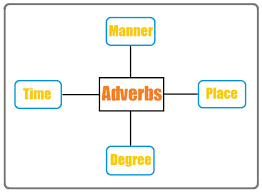
Types of Adverbs

adapted from myenglish.com
Adverb of Manner– refers to how something happens or is done.
- Mary carefully sat down.
Adverb of Time- this states “when” something happens or done.
- Time for an early bath.
Adverb of Place– this tells something about “where” something happens or is done.
- Wow! They are everywhere!
Adverb of Degree– this states the degree to which a specific thing happens or done.
- Today is very cold

adapted from pronouns.com
Adverbs of Degree
Interesting , more interesting
- A really interesting topic
- A very interesting topic
- An extremely interesting topic
- The extremely tasty food
- The very tasty food
- The somewhat tasty food
- The mildly tasty food
- The barely tasty food
- The almost tasty food
- The nearly tasty food
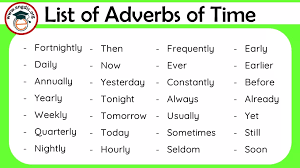
Adverbs of Time
- daily
- weekly
- annually
- nightly
- then
- now
- today
- tomorrow
- frequently
- ever
- always
- sometimes
- soon
- early
- already
- before
Relative Adverbs
- Question Where did you grow up?
- Adverb Europe is where I grew up
- ‘relates’ Europe to I grew up
- Question When did you learn English?
- Adverb I learnt English when I was a child
- ‘relates’ learnt English to a child
- Question Why do you like to study?
- Adverb I don’t know why I just do
- ‘relates’ don’t know to just do
WHEN
now
soon
always
sometimes
previously
early
later
afterward
never
recently
WHERE
here
there
everywhere
nowhere
across
away
inside
far
upstairs
outside
HOW
gently
smoothly
carefully
loudly
safely
quickly
slowly
easily
fast
well
HOW OFTEN
always
usually
often
sometimes
rarely
seldom
never
frequently
occasionally
normally
HOW MUCH
very
too
quite
almost
nearly
absolutely
totally
completely
partially
barely
Lesson Exercises
Worksheets
Exercises
Conversation Practice
- #1: Hello, I’d like to order some food.
- #2: Hi! Sure. What would you like to order?
- #1: I want some fried rice and spring rolls.
- #2: Okay, fried rice and spring rolls. Anything else?
- #1: Yes, can I get a bottle of green tea?
- #2: No problem. Your total is $10. It will be ready in 20 minutes.
- #1: Actually, can I also add a side of dumplings, please?
- #2: Of course! Would you like the dumplings steamed or fried?
- #1: Steamed, please.
- #2: Got it. So, fried rice, spring rolls, a bottle of green tea, and steamed dumplings. Is that correct?
- #1: Yes, that’s right. How long will delivery take?
- #2: It will take about 30 minutes. Your new total is $15
"The girl ran quickly."