
🎓Core English
Build confidence speaking and understanding English for university
Core English Pronouns
Learn with a university lecturer with vast experience preparing students for success at university
Home > core English > pronouns
Core English pronouns is an introduction to a variety of types of pronouns and how they are used in the English language.
What is a Pronoun?
- Pronouns replace or refer to a noun (noun phrase)
- John was at work all day, he was tired.
- he refers to the noun John
- Emma had a cup of coffee, she drank it then went out.
- she refers to the noun Emma, it refers to the noun phrase ‘a cup of coffee’
Use pronouns to replace the subject or object
- The boy kicked the ball
- He kicked the ball
- The boy kicked it
Notice we replace the nouns, but also the article with the noun
- The boy-> he
- The ball -> it
Use pronouns to replace the noun phrase:
- The tall boy kicked the blue ball
- He kicked it
- A young boy kicked an orange ball
- He kicked it
- A good artist can paint a tasty apple
- She/He can paint it
Personal Gender
Replace the underlined noun with the correct pronoun:
- My friend likes soccer. _____ plays it every day.
- My friend likes soccer. He plays it every day.
- My friend likes soccer. She plays it every day.
Personal Agreement
- Wrong: “Me and him went to the store”
- Correct: “He and I went to the store.”
Personal Pronouns
- I am happy
- You and I are learning English
- You have a nice bag
- She is my friend
- He plays soccer
- It is a cat
- We like ice cream
- They are students
- She and he are siblings
- We love our parents
person | singular | plural |
1st | I | we |
2nd | you | you |
3rd | she / he / it | they |
Subject and Object Pronouns
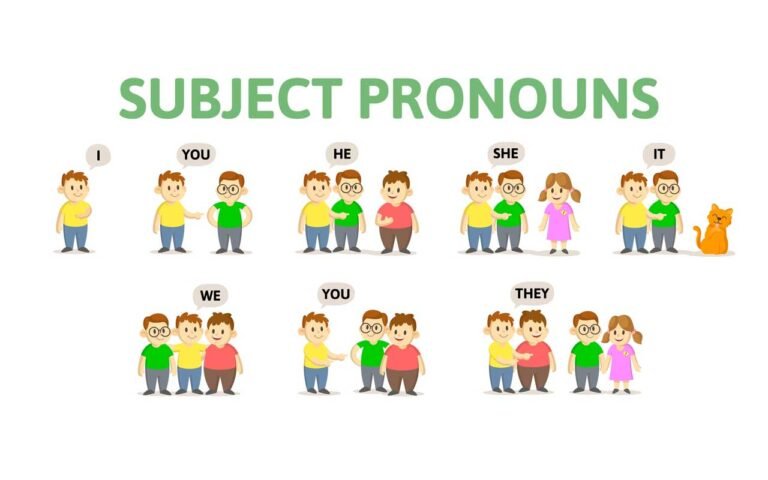
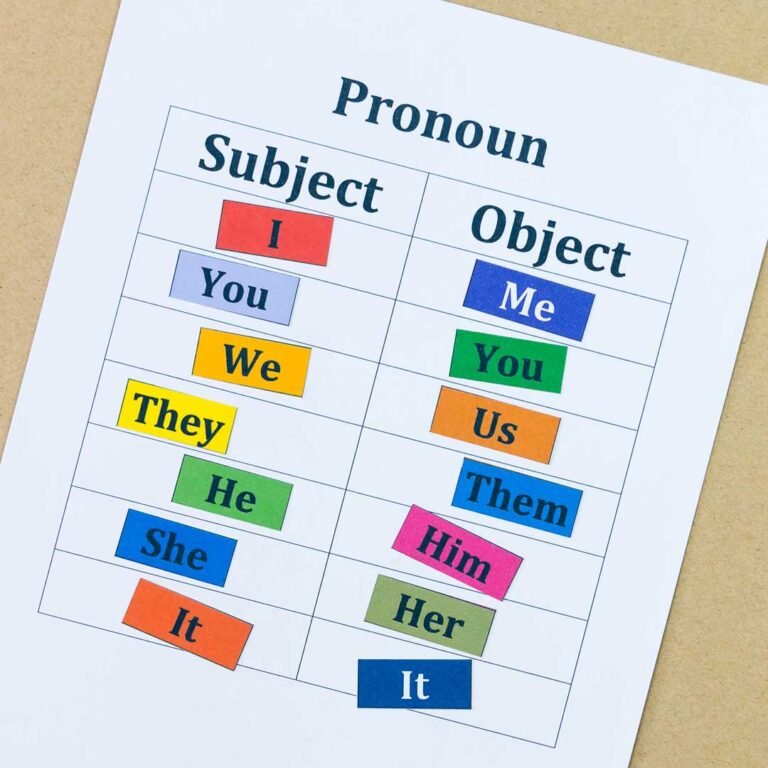
Subject pronouns are used as the subject of a sentence – I, you, he, she, it, we, they
- I went to school
- She was there
- It was red
- We went together
- They were cold
Object pronouns are used as the object of a verb: me, you, him, her, it, us, them
- The ball hit me
- It is up to you
- The car is owned by him
- The cat looked at us
- Share the cake between them
English Pronouns
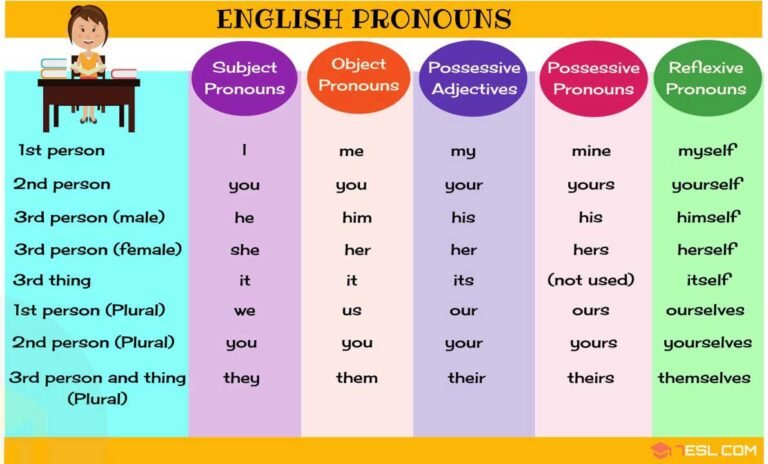
Image source: https://7esl.com/english-pronouns/
Possessive Pronouns
- to possess is to own
No ‘ in possessive pronouns
like a noun
- mine
- ours
- yours
- hers
- his
- its
- theirs
like an adjective
- my
- our
- your
- her
- his
- its
- their
- That book is my book – used as an adjective
- That book is mine – used like a noun
- Mine is the red one – used like a noun
- That is Jon’s cat (Jon is a proper noun)
- That is his cat (his used as a possessive adjective)
- The cat is his. (his is used as a possessive pronoun)
Reflexive Pronouns
- I hurt myself when I fell off the bike.
- She looked at herself in the mirror and smiled.
- He always talks to himself when he’s alone
- The cat is grooming itself.
- You need to believe in yourself to succeed.
- They cooked dinner themselves last night.
- We should be proud of ourselves for finishing the project on time.
refers to the same thing
- I – myself
- She – herself
- He –himself
- The cat –itself
- You – yourself
- They –themselves
- We – ourselves
Relative Pronouns
put phrases together
- that
- who
- which
- whom
- whose
- where
- The book that I am reading is very interesting.
- The person who won the race is my friend.
- The car, which is blue, belongs to my brother.
- This is the house where I grew up.
- She is the one whom we chose as the team captain.
- The cake that you baked was delicious.
- The movie, which was released last week, received great reviews.
- The man whom I met yesterday is a famous actor.
- The dog that barks loudly lives next door.
- The project, which took months to complete, was a huge success.
Lesson Exercises
Worksheets
Exercises
Exercise 8.5 Pronoun Practice (see above)
0. John and I saw Peter yesterday. He bought John and me a cup of coffee |
___We___ saw Peter yesterday. He bought _____us_____ a cup of coffee |
1. David and Mike are arriving today. I’m meeting David and Mike at the station |
______________are arriving today. I’m meeting ______________at the station |
2. I’m looking for Mary. Have you seen Mary? Mary isn’t at home. |
I’m looking for Mary. Have you seen ____? ____ isn’t at home. |
3. John and I saw a film called ‘The Tiger’ yesterday. Have you seen ‘The Tiger’? |
_________ saw a film called ‘The Tiger’ yesterday. Have you seen __________? |
4. Come to the swimming pool with Joanna and me. Joanna and I are leaving now. |
Come to the swimming pool with _____________. ___________ are leaving now. |
5. George and Jane are meeting Paul today. Paul is having lunch with George and Jane. |
______________ are meeting Paul today. ____ is having lunch with ______________ . |
6. There’s Jack! Jack’s got a heavy suitcase. Shall we help Jack? |
There’s ____! Jack’s got a heavy suitcase. Shall we help ____? |
Useful Resources & Links
"John and I saw a film yesterday."
"The ball hit _______."
"That book is _______." (it belongs to me)
Congratulations - go to the next lesson!
Lesson 9 Adverbs
coming next week