
🎓SAT English
GRAMMAR 2
SAT Pronoun Agreement for ESL Students
The only free SAT English prep designed specifically for ESL students
Home > SAT English > Grammar 2: Pronoun Agreement
SAT Pronoun Agreement helps ESL students learn how the pronoun and the noun it refers, called the antecedent, match in number (single or plural), person and gender in SAT English questions.
Why Learn Pronoun Agreement
For English language learners, the agreement of pronoun and antecedent helps
- Reading: readers need to understand to whom or what the pronoun is referencing.
- Understanding: both number and gender understanding are essential in grammar to understand the text
- Avoid repetition: writing is easier and more natural when pronouns replace nouns over multiple sentences or phrases.
- Avoid errors: when the pronoun and the antecedent mismatch the sentence is wrong and both listeners and teachers will consider the error as poor English.
Grammar Rules: Pronoun Agreement
the pronoun in a sentence agrees with its antecedent in terms of number (singular or plural), person (e.g. it/they), and gender (he/she/it).

- Pronoun = their
- Subject noun (antecedent) = students
- Both plural (students – their)
- Pronoun = her
- Subject noun (antecedent) = Vicky
- Both single, female, third person (Vicky – her)
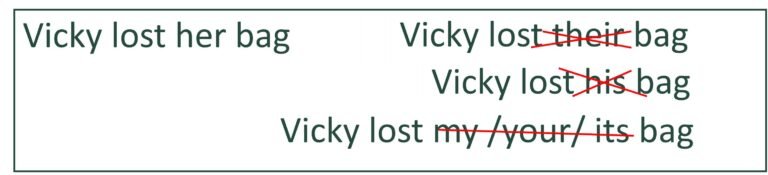
How to know if the pronoun and antecedent agree
Exercise 1 Pronoun agreement
these are questions ranging from easy to difficult – but have been simplifed
Choose the Correct Option
Advanced examples for pronoun and antecedent agreement
The 5 types of questions include:
- simple single agreement in number
- simple plural agreement in number
- plural and person agreement (first)
- number and (third) person agreement
- more advanced agreement (third-person plural)
Types of questions – Digital SAT Pronoun Antecedent Agreement Examples: Types of Questions
SAT grammar questions used to have “no change” as the ‘A’ option, but have recently stopped using this format.
Exercise 2 SAT style questions
these are SAT questions taken from the College Board / Khan Academy
Choose the Correct Option
More Help
- Resources for both pronoun-antecedent agreement and subject-verb agreement: Digital SAT Grammar Agreement
- Types of Pronoun agreement SAT questions: Pronoun-antecedent agreement examples
- Practice Exercises for pronoun agreement: DSAT Practice questions for pronoun agreement
Advanced SAT Grammar Rules
The pronoun must agree in number
Singular antecedent: “The cat licked its paw.”
Plural antecedent: “The cats licked their paws.”
The pronoun should agree in person
A third-person antecedent should not be followed by a second-person pronoun.
❌ “The manager told you to complete the task.”
✅ “The manager told him to complete the task.”
Indefinite pronouns like ‘anybody’, ‘each’, ‘everyone’ are always singular
Even if they refer to many people:
✅ “Everyone has his or her ticket.”
✅ “Everyone has their ticket.” (modern usage)
Pronoun matches its referent even if the antecedent comes after
“When she arrived, the manager greeted the team.”
Collective nouns like ‘team’ or ‘class’ are singular unless the meaning is plural
✅ “The jury gave its verdict.”
✅ “The jury took their seats.” (if acting as individuals)
SAT pronoun agreement questions explained
Digital SAT Grammar Vocabulary
- Antecedent: the noun the pronoun replaces
- Referent: the word a pronoun refers to
- Compound antecedents: two or more nouns joined together
- Correct pronoun: one that matches in gender, number, and person
- Personal pronoun: I, you, he, she, it, we, they
- Singular or plural depending on context: words like none, all, or some
- Pronoun takes the place of a noun: so clarity and agreement matter
SAT questions
Do you wish to try Khan Academy SAT practice questions now? Pronoun Agreement | Lesson